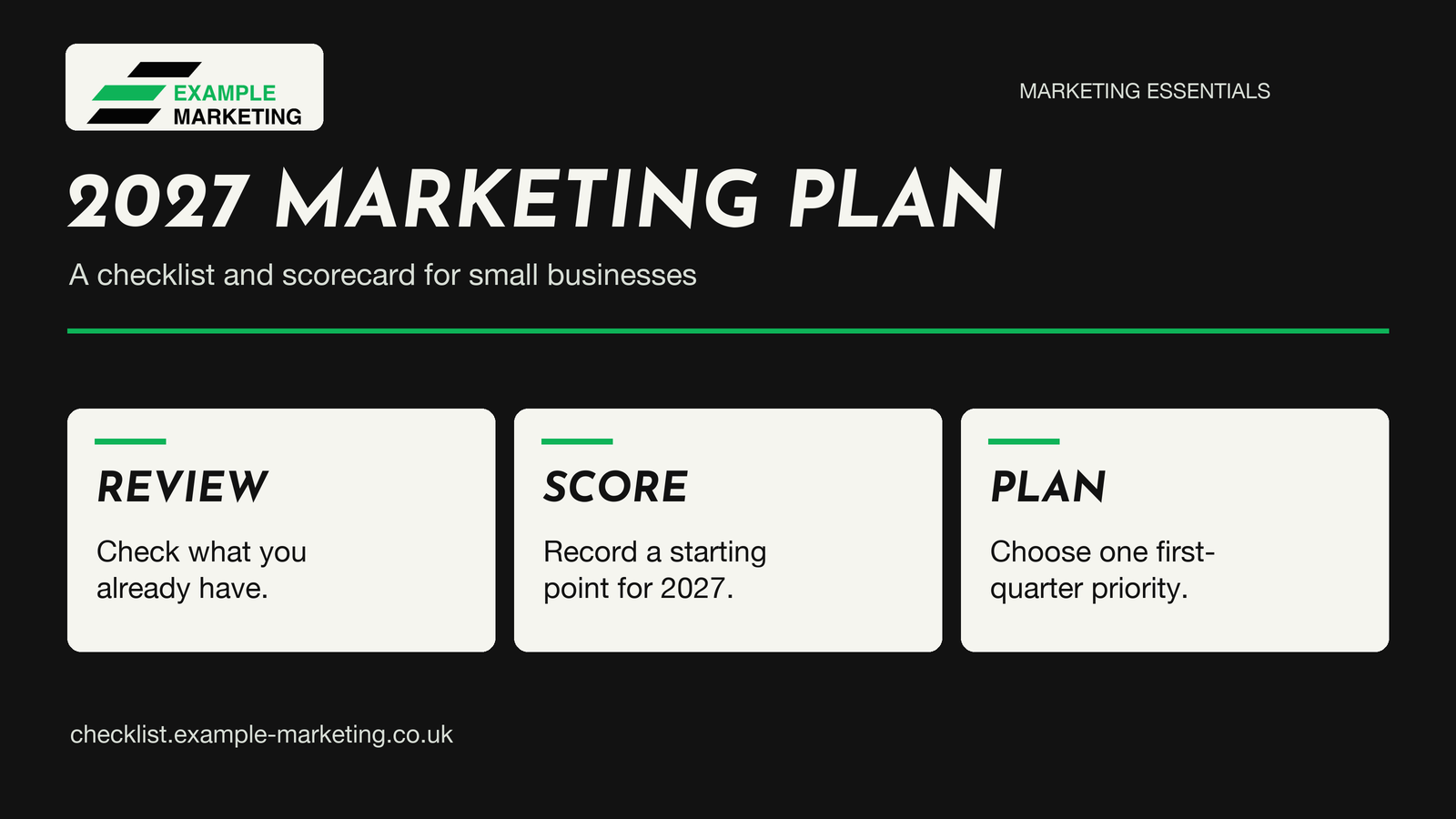
How to make a 2027 marketing plan for your small business
Use an eight-point marketing checklist and the Example Marketing Scorecard to set a baseline and give your first-quarter priority an owner and a review date.
Start your 2027 marketing plan with three decisions. What should marketing help the business achieve? Where are suitable customers getting stuck today? What can somebody on your team improve and review in the first quarter?
You can make those decisions with evidence you probably already have. Gather your website, recent posts and emails, campaign reports and a few real enquiries. Use the Example Marketing Content Essentials Checklist to work through eight areas, then use the scorecard to record where you stand.
Agree on one outcome for 2027
Choose a business outcome before deciding how often to post, whether to run ads or which channels to add. A service business might want more enquiries for a specific service, more repeat work from existing customers, or a better fit between the people who enquire and the work it can take on.
Make the outcome specific enough to guide decisions. If you want more suitable enquiries, agree what a suitable enquiry looks like and whether your team has room to follow up. For example, you might look for enquiries from a particular type of business, in an area you serve, for work you can deliver.
Review the eight marketing essentials
For each area, write down what you checked, what you found and what needs attention. If you cannot tell how something is performing, record the evidence you need.
- Social media. Check whether your profiles explain who you help and whether recent posts answer questions your customers ask. Follow the next step from a post through to the relevant page.
- Email marketing. Read your most recent sends and check who each one was for, what it helped them do and where the main link led.
- Paid advertising. Follow one advert through to the destination page and enquiry. Compare the conversions you report with the enquiries or sales your team recorded. Use our paid advertising preparation guide if you are reviewing spend.
- SEO. Pick an important service page and look for the questions a buyer needs answered before making an enquiry. Check whether they can find the page and understand your offer once they arrive.
- User experience. Try your main enquiry journey on a phone. Check that the form works, the confirmation makes sense and the message reaches the person who is meant to respond.
- Reviews and collaborations. Check whether people can find relevant proof of your work. For a collaboration, agree how both parties will handle the enquiries it may bring.
- Promotions and local activity. Look at what happens after an event, introduction or promotion. Give people a clear way to follow up and agree who will handle responses.
- Analytics. Decide which figures help you make a decision. Use the same reporting period and compare meaningful events, such as received enquiries, with the records your team actually uses.
The checklist lets you rate each item and generate a report. Read the sections together. If social posts are bringing people to the site but the main enquiry form is hard to complete, improving the form could be a better first job than adding posts. Our guide to building a simple marketing funnel explains how to connect those steps.
Record a starting point with the Marketing Scorecard
Use the Example Marketing Scorecard to capture a baseline for your 2027 plan. It has ten scored questions and five context questions about your business and goals. Your scored answers give you a result out of 50.
Answer from a recent example where you can. If you think you know where enquiries come from, pick one and see whether you can follow it back to the activity that brought it in. Keep the date, your result and any answers you found hard to give. The score records your self-assessment. The examples behind your answers help you decide what to change.
Give your first-quarter priority an owner and a review date
Choose one issue that is getting in the way of the outcome you picked. Make the first action small enough to finish, assign it to one person and agree when you will look at the results.
Imagine a service business that receives enquiries from a website form, but nobody can tell which messages have been picked up. A practical first-quarter plan could look like this.
- First action. Run a labelled test on mobile and agree who checks the inbox and records the next step.
- Owner. Give the website or marketing lead responsibility for the test and ask them to agree the handover with whoever replies to enquiries.
- Evidence. Look back at how many enquiries had a named owner and a logged response, then check those same measures after the change.
- Review. Put a date in the diary before the end of March. Use the review to decide whether the handover is working and what needs attention next.
You can return to the same checklist items and scorecard questions at the review. Compare like with like and note anything that changed, such as a new offer, paused campaign or different reporting period.
Start with the Content Essentials Checklist and use what you find to choose a first action your team can take in January.
Want to improve your marketing?
Talk to us about what you're trying to achieve and we'll tell you honestly whether we can help.

